Thursday, July 20, 2006

Shanghai: city of contrasts

I landed at Shanghai Pudong airport pretty late. I went through immigration and customs very quickly. Especially in the summer, I try to travel always with only carry on luggage.
As soon as I appeared at the arrival hall, the driver waved at me. He has picked me there several times in the last weeks. It was hot and humid. We walked to the carpark and started our drive from Pudong to the city. The strong air conditioning was relaxing and refreshing.
I was staying at the JW Marriott. I arrived in my room and laid down on my bed for a while. I was tired, the flights, the heat, the jet lag, meetings during the day, e-mail and teleconferences in the evening.
I took a shower. Most of the rooms at JW are fantastic. The hotel is pricey (about $400 a night), but it is worth the while. My shower was directly onto the window panel. If you dim the lights, you can see the Pudong skyline while you shower. The steam gave the city a mysterious look. I felt much better.
I put on my jeans and a T-shirt. I looked down from the 47th floor and I saw the contrast of this city of 16 million souls. Ultramodern high rise buildings in the middle of old and run down housing complexes. Many of them will not be there anymore when I come back next time. I saw several white, red and blue spinning signs in one of those complexes. I needed a hair cut and a head massage (gen xi tou).
In a few minutes I was in one of those little shops. It was midnight. The hairdresser, a young guy, looked tired. I explained to him what I wanted. He washed my hair, gave me a head massage and cut my hair. He did a great job. He looked so tired. Maybe he had been working since 9 in the morning. It was past midnight now.
I asked him how much I owed him. He told me RMB 10 (US$ 1.25). I never give tips, because I do not like to alter the market price. This time I broke my rule (I would do that later again) and I gave him RMB 20.
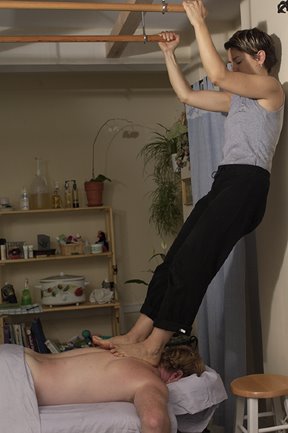
I felt I still needed a body massage. I wandered around. It was a bit risky, because I did not know the area well. I saw another shop with the spinning sign.. In the outside there was a sign with the price list. A one hour massage for RMB 30 (less than US$ 4). I ventured in. It was almost 1am.

Saturday, July 01, 2006

Japan: watersports and no money at midnight

My flight from Shanghai to Tokyo was delayed due to weather. I landed in Narita at 11pm. Since I was going to stay in Japan for a day (I actually extended my stay one more day), I decided upon arrival to visit the restroom in order to give you a follow up on my previous posting “Pissing Dutch”.
The first thing you notice is that the restroom experience at Narita airport is a matter of trust. There is no lock in the door. The system detects that there is someone inside and blocks the access to another person. The toilet has all kind of controls and there are water jets in all directions. But attention guys, if you manipulate the controls while standing, make sure that you use eye protection gear. Otherwise you may find a powerful jet of water going directly into your eye and I do not think that this is what the designer was thinking when he developed these gadgets.
I also found something that you single people may find irrelevant, but it is vital if you have little kids. It is a kind of wall mount to hold naughty children. You simple place them there and forget about them for a while. However I was not able to figure out the use of the foldable stretcher inside the restroom and I leave it for your speculation.

When I got to the arrival hall, an airline employee told me that due to the late arrival of the plane, the only possibility to go to the city was to take a free bus to Shinjuku railway station. The ATM machine did not operate after hours, the bank was closed and I did not have a single Japanese yen.
During my one hour ride, I defined my game plan. I saw three possible alternatives:
Take a taxi that would take Amex credit card
Try to find an ATM machine that would accept my cash card and then take a cab
Take a cab to the hotel and change some money at the hotel service desk upon arrival.
Many options, nothing to worry.

However I realized that I had forgotten a basic requirement, a piece of advice that I always give to people traveling to countries that do not use the Roman alphabet. I did not have the name of the hotel written in Japanese characters (neither katagana, nor hiragana, nor kanji). I was supposed to stay at the Meridian Pacific.

When I arrived to the Shinjuku station I saw a long cue of cabs. I went to the first one, I opened the door and I showed my Amex to the driver. He said “hai, hai”. My first problem, payment, was solved.
Then I showed him the hotel name on my itinerary and he shook his head. Then I tried the basic trick to translate foreign words to Japanese. Use the 5 Spanish vowels AEIOU and end the word with a U (pronounced “oo”). So I told him Meridianu Pasifiku. He said Pasiku, Pasiku. I looked close enough to me and I said “hai”. He was not convinced, so he asked me the phone number. I wrote it on a piece of paper, after adapting it to what I thought would be the local form of it. He punched the numbers on the keyboard of his GPS navigator and a 3D building appeared with superimposed characters. Pasiku, Pasiku! He exclaimed. He drove through Ropongi district and shortly after, we arrived at the Meridian Pacific, a.k.a. Pasiku, opposite to Shinagawa station. It was 1 am.Posted by Picasa

Sunday, June 04, 2006

Je parle Québecois

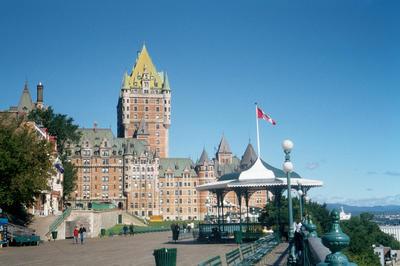
I spent the long Memorial weekend in Québec, half of the time in Montréal and the other half in Québec city. Many things reminded me of Catalonia. Graffiti with independentist slogans painted on some walls, the notorious absence of the Canadian flag even in some public buildings, the seamless mixture of French and English in most public places (similar to the coexistence of Catalan and Spanish in Catalonia).
My perception is that in Montréal more English is spoken than French. When I arrived, I was so excited because I thought I was going to use my French and show off in front of my wife and kids, but the reality is that I mostly used English, since everyone spoke English better than me. The city is a bit disappointing, not much to see and with a waterfront that requires a serious face-lift. I also found prices extremely expensive, not only because we went there without any type of reservations, I always make last minute decisions that I pay dearly, but my impression is that they kind of rip off the tourists.
Québec city is different. I highly recommend to go and visit it. It is the only city in North America (US or Canada) where the colonizers build beautiful permanent structures. The old buildings and alleys are fantastic. You could be in any historical European city. In addition to the wonderful atmosphere, French is spoken throughout, or at least Québecois, the variety of French spoken there that requires quite some additional effort to understand. But I managed. And people were nice to me.
However I started to realize how Americanized my family and I are getting. We missed some of the conveniences that we have in the States, and we even became upset because we did not find any open pharmacy where to buy diapers at midnight. When we finally crossed the border to Vermont and the immigration office told us some nice and funny words, we felt back home.

Saturday, May 20, 2006

Pissing Dutch

Dutch are well known for their water related civil engineering and their liking for water sports. This combination has also made Dutch become leaders in male urinal innovation (Japanese lead the female related R&D).
Barcelona mayor Clos, in his civic drive, should visit the Netherlands and learn some of the key elements that make civism and human nature compatible. Some of the solutions are simple and, at the same time, ground breaking. As an example I will give the fly engraved in Schiphol airport urinals. Airport statisticians working in the janitor department report that the amount of spilt urine has gone down by 80% what had as a consequence a reduction in force of 20% of the janitor crew and 30% reduction of the cleaning chemicals used to wipe out such a corrosive substance. Between you and me, it is also fun aiming at the little insect.
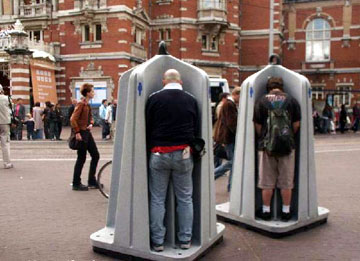
But this is not all, partying Dutch males who after drinking an undisclosed amount of beers need to give back to nature what they ingested, can make use of the highly sophisticated portable urinals strategically located near bars and other alcohol serving entities, as you can see in the picture. There have been some sightings of females using this facility, although no documented proof has been provided. For the time being, I consider it a pure rumor.
However I would like to warn mayor Clos not to go on a shopping spree and buy this standard equipment from The Netherlands. With my 5 ft 11", I find it sometimes difficult to use the Dutch urinals who have been designed for the Dutch, who are, in general, 4 to 6 inches taller than the Catalans. So, Mayor Clos, please buy a customized version. Otherwise so much pulling and stretching may result in infertility problems which may reduce, even more, the dwindling birthrate in Catalonia.

Out of modesty, I will not comment on the Japanese innovations for female users of the lavatory facilities. Fake waterfall background music to mask physiological noises and remote controlled joysticks to direct the toilet bowl water jet, are things I have no experience with.

Sunday, May 14, 2006

Zom una nazió

Last Sunday I arrived in Barcelona in a surprise visit to my younger sister. It was her birthday and I decided to show up without warning. It took her a few seconds to recognize me, but I made her day. It was worth while flying for 10 hours 5000 miles.
We ate cake, blew the candles and drank an excellent cava, Juvé i Camps.
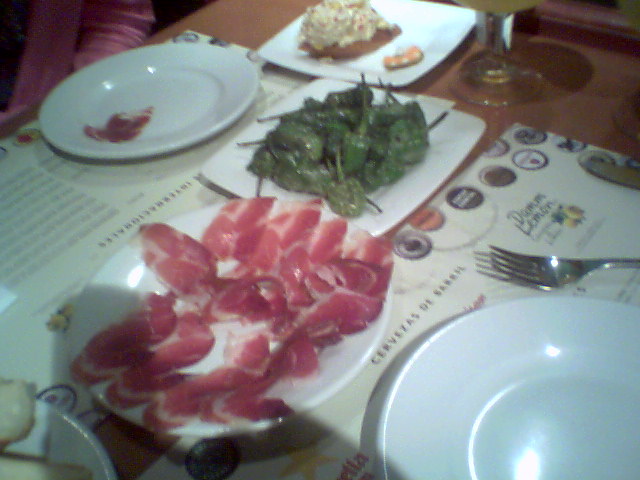
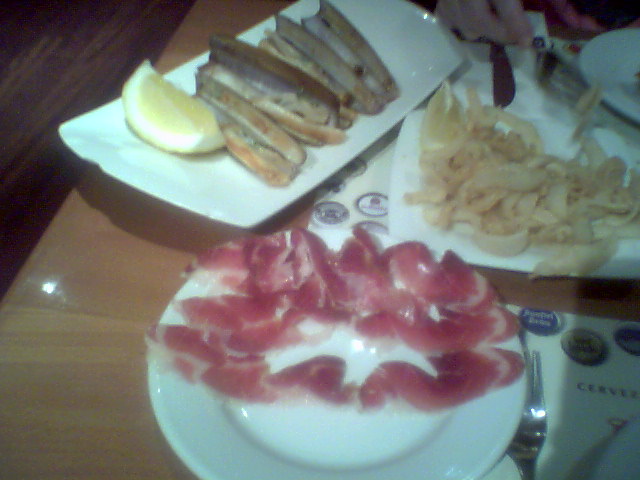
She treated me for dinner at a “tapas” bar at the Rambla Catalunya called “Ciutat Comtal”. They have excellent “tapas”, but it is a real “guirilandia” in miniature. It was full of foreigners and half guiris like me. “Tapas” are great. I had two plates of Jabugo ham and Andalusian “chocos” (squid) to show my support for the Andalusian national caliphal reality and “Padrón” peppers and Galician “navajas” (razor clams) to show my support for the Galician national Celtic reality and, of course, a heavily boycottable Catalan “cava”.
A few days ago, I had emailed my friends telling them that I would be in BCN for a day and asking them whether they would have some time for lunch. They all replied positively with only one condition. Lunch had to be short, not more than 2 hours (1:30pm to 3:30pm). I arrived a bit late (1:35pm), the place was a bit hard to find. The first one, J, arrived at 2.05pm, the second one, L2, at 2.25pm and the third one, L1, at 2.30pm. We had a good lunch and a good conversation. At 4.30pm, they had to “rush” to work. However, do not get the impression that the did not work his 9 hours or more. For sure they were in the office until 8 or 9pm. Barcelona, what a great place!!!

Once again, I was able to verify personally that all those lies spread by the biased media, (Libertad Digital, some contibutors to Barcelona Reporter, ABC, El Mundo, etc.) have absolutely no foundation. This is my experience of one day as a customer in Barcelona:

Lunch - El Balanci - waitress: Portuguese - I started ordering in Catalan - Waitress replied in Spanish – I switched to Spanish
Dinner – Ciutat Comtal - waiter: Filipino - I started ordering in Catalan - Waiter replied in Spanish – I switched to Spanish
Police Station (for national ID renewal) – policeman: Castilian, probably from Valladolid or Burgos – I asked my question in Catalan – Policeman replied in Spanish – I continued asking in Spanish
Airport security – screener: from South America, probably Peru – She asked me to remove my laptop and belt in Spanish. – I obeyed in Catalan.

As you see, “zom una nazió” .

Wednesday, May 03, 2006

Catalanity test

This is a simple Catalanity test.
Watch this video of Pau Casals addressing the General Assembly of the United Nations, the day that his hymn of the United Nations was presented.

  1. If tears come to your eyes and you get goose pimples on your skin, you are a real Catalan
  2. If you get upset, you are a Spanish nationalist who most probably votes for the Popular Party
  3. If you feel nothing, you are not a Spaniard
  4. And if you are a Spaniard and still feels nothing, you'd better brush up your English


Note:
History of the unofficial hymn of the United Nations

One such song, or hymn, was written and performed at the United
Nations on 24 October 1971, on the occasion of the 25th anniversary of the United Nations, by Maestro Pau Casals of "Catalonia". The words were written by poet W.H. Auden of the United Kingdom.
The two, though they had never met, were brought together in this unusual collaboration by then United Nations Secretary-General U Thant. For centuries, poets and musicians have sung in praise of war and celebrated victories in battles. U Thant was intrigued by the fact that there existed no hymn to peace.
Pau Casals was a personal friend of his, and when approached by U Thant, he readily agreed to write the music. As the Secretary-General explained, the song was to be based on the preamble to the Charter of the United Nations. Although it would not be formally adopted as the official anthem of the United Nations, U Thant hoped it would be performed on appropriate occasions.
While Casals greatly liked the ideas contained in the preamble, there was no way he could put music to such a document. The task to write an appropriate poem, based on the theme of peace and ideals enshrined in the preamble, fell on W.H. Auden, then regarded as the greatest living English poet. When a representative of the Secretary-General approached the poet, he immediately agreed to write the poem. In three days’ time, Auden finished writing A hymn to the UN, which was then set to music by Casals.
On 24 October 1971, the Orchestra of the Festival Casals, with the Maestro himself as conductor, presented the hymn in a première performance at UN headquarters.

A Hymn to the UN
Music: Pau Casals Words: W.H. Auden

Eagerly, musician.
Sweep your string,
So we may sing.
Elated, optative,
Our several voices
Interblending,
Playfully contending,
Not interfering
But co-inhering,
For all within
The cincture
of the sound,
Is holy ground
Where all are brothers,
None faceless Others,
et mortals beware
Of words, for
With words we lie,
Can say peace
When we mean war,
Foul thought speak- fair
And promise falsely,
But song is true:
Let music for peace
Be the paradigm,
For peace means to change At
the right time, as the World-
Clock
Goes Tick- and Tock.
So may the story
Of our human city
Presently move
Like music, when
Begotten notes
New notes beget
Making the flowing
Of time a growing
Till what it could be,
At last it is,
Where even sadness
Is a form of gladness,
Where fate is freedom,
Grace and Surprise

This fact sheet was issued by the Public Inquiries Unit,
Department of Public Information, United Nations.
Tel.: 212-963-4475; Fax: 212-963-0071; E-mail: inquiries@un.org
Website: http://www.un.org/geninfo/faq

Tuesday, May 02, 2006

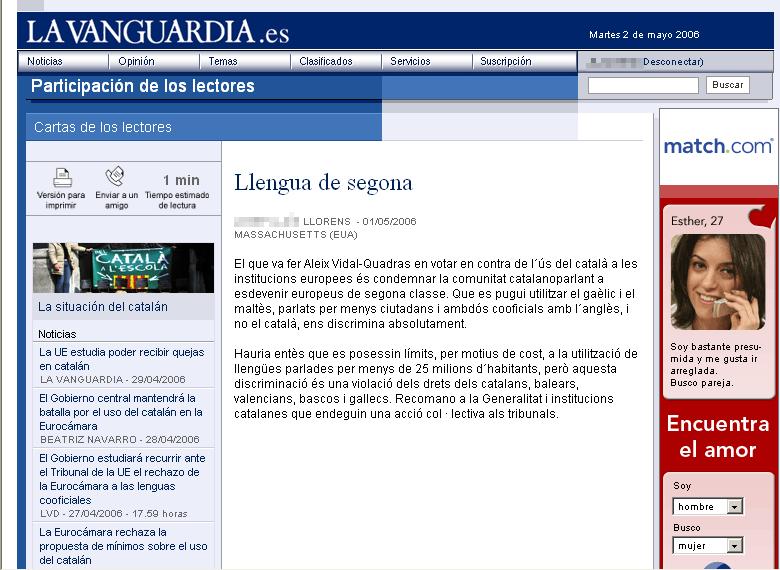
Ian Llorens versus the European Union


A close relative of mine, who also happens to live in Massachusetts, got published the attached letter in the Spanish newspaper La Vanguardia. He tells me that when you send a letter to La Vanguardia, several things happen: they always give it a haircut, without any reason, even if the letter is relatively short. They love to edit it. The result is very often a little bit awkward, but the truth of the matter is that the try to keep the essence of the message.
The second thing that happens is that they correct your spelling and grammar mistakes, even though Bill Gates takes care of the first ones through his outstanding word spell check (in this case for Catalan). But my relative never learnt Catalan at school, it seems that it was banned when he studied, and from time to time, he makes some grammar mistakes, like making intransitive transitive verbs. He does not feel bad about it, however, because in the Valencian variety of Catalan, the construction would have been correct. There is always a loophole.

This is the English version of the article:
"Second class language
What Aleix Vidal-Quadras did when he voted against the use of Catalan in the European institutions, was to condemn the Catalan speaking community to become second class Europeans. The fact that Gaelic and Maltese, spoken by far less citizens and both of them co-official with English, can be used and not Catalan, discriminates us absolutely.
I would have understood that limits are imposed on languages spoken by less than 25 million people due to cost reasons, but this targeted discrimination is a violation of the rights of Catalans, citizens of the Balearic islands, Valencians, Galicians and Basques. I advise the Catalan government and institutions to file a class action lawsuit."

This is the original modified version in Catalan:

"Llengua de segona

El que va fer Aleix Vidal-Quadras en votar en contra de l´ús del català a les institucions europees és condemnar la comunitat catalanoparlant a esdevenir europeus de segona classe. Que es pugui utilitzar el gaèlic i el maltès, parlats per menys ciutadans i ambdós cooficials amb l´anglès, i no el català, ens discrimina absolutament.

Hauria entès que es posessin límits, per motius de cost, a la utilització de llengües parlades per menys de 25 milions d´habitants, però aquesta discriminació és una violació dels drets dels catalans, balears, valencians, bascos i gallecs. Recomano a la Generalitat i institucions catalanes que endeguin una acció col · lectiva als tribunals."


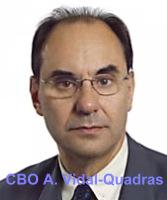
For those who do not know him, Aleix Vidal-Quadras is one of the vice presidents of the European parliament. He is a Catalan, member of the right wing popular party and he was the swing vote against the resolution to allow us to be able to communicate with the Eurochamber in Catalan. He is a clear example of why Catalans have never won any war in the last 600 years, there was always a "botifler" (traitor) that would sell our interests. Note that out of 14 vice presidents, there are 2 Catalans, that's 15% of the presiding body. I really cannot understand.

When asked, Aleix said that he had voted against due to technical reasons, the complexity of having even more languages in the E.U.

This is my answer to that:
  • You know my opinion about languages in the EU. Only English should be use by the people who work there (most probably a more legally acceptable compromise would be, however, that the 3 european union languages that are also official in the United Nations, become the three working languages in the EU: English, Spanish and French)
  • Communication between the citizens and the EU should be in the official language of the citizen. A webportal set up and paid by the regional or national government, should act as intermediary.
  • What you you cannot do is a targeted ethnic discrimination. If you are Maltese, you can use your small little language, if you are Catalan, you cannot. THIS IS A CIVIL RIGHT VIOLATION. Therefore I encourage all you Catalans to file a complaint to the European Ombudsman following this link.
  • Finally I would like to add that all these problems will be solved in 15 to 20 years. Today I attended a series of speaches/presentations at the JFK Library in Boston organized by MassMedic. One of the keynote speakers, Ray Kurzweil talked and demonstrated the future of interpretation with the improvement in computation. He predicted that in the next decade, google-kind interpretation algorithms will be built in our cell phones in such a way that when you call a colleague or friend in Germany, you will be speaking English and your counterpart will be hearing the same conversation in German. Both the software and the computation power will be available in any handheld device. I start to wonder why I learnt 9 languages. Looking from this perspective, Mr. Vidal-Quadras becomes irrelevant.


Saturday, April 22, 2006

Vendrell: Catalonia's new CEO

We, Catalans, are masochistic by nature. We not only have lost every single war in the last 600 years (we did pretty well before that time), our national day commemorates a defeat and guess what, it falls on September 11th (do not take it personally, it's been like that for almost 300 years, but it kills me that I cannot even celebrate my national day in the States) , but also we have a broken hand when choosing our politicians.
Our last achievement in the political arena has been the appointment of Xavier Vendrell, the famous alleged CEO (Chief Extorting Officer) as our new Interior Minister ("Conseller de Governació").
As you may remember, Xavier Verndrell allegedly sent letters to all those who had been hired to work in the departments ruled by his party (Esquerra Republicana Bananera de Catalunya) telling them that if they did not contribute part of their salaries to the Party, they would be fired on the spot, and some were indeed fired.
This guy is now responsible to appoint the chief prosecutor that will investigate his alleged crimes. It is believed that he is close to a deal with the former prosecutor in Aruba of the Natalee Halloway case, but he is still open to other options if they are proven to be even more incompetent.
Should I have a Catalan passport (something that I have longed for some times), I would tear it to pieces right now. I love Massachusetts more and more.

Wednesday, April 19, 2006

Andalusia: national reality

In the new Andalusian Statute, Andalusia will be defined as a “national reality”. What’s a national reality (“realidad nacional”)?, have I made an error in translation? Did I actually mean a national realty? No, they really mean a national reality, what is a euphemism for nation.
Yes, Andalusia has defined itself as a nation. To be frank, I could not care less how the Andalusian people define themselves. I like people from Andalusia and I like their land, even though I do not share many of their values and priorities in life. But diversity is what makes the Iberian peninsula such a wonderful place.
But the big surprise to me is that there is no uproar in Spain because of this. I would have expected a call by the Spanish hardcore nationalists to boycott the Jabugo ham, the Seville olives or the Andalusian ‘fried fish” (“pescaito frito”) and the proliferation of websites attacking Andalusia for its attempt to create a nation within a nation. But nothing of this has happened. Most of the Spanish right-winged press have criticized it a little bit, but they all have put the blame on Catalonia (!?), as you can read by yourselves in the linked article that appeared, guess where, in ABC newspaper.
As I said, I do not care how the Andalusians call themselves. No matter whether they are a nation, a region, a nationality or an empire, I will continue to consume their products and visit their land, even if sometimes I am called names, because I am a Catalan. I will continue to eat as much Jabugo Ham with cava, whenever I go back home and cry every time that the US customs officer confiscates my 2 pounds of Jubugo ham at the port of entry.
But it is obvious that in Spain there is a triple standard, a virulent reaction against Catalonia, a subdued reaction against the Basque country (most probably out of fear) and tolerance vis a vis the rest of the peoples in the Iberian peninsula. Why? I remember that about 20 years ago I saw a program on Spanish TV where a reporter was asking people in Andalusia what they thought about Catalans in a point of time where the political situation was extremely quiet. Many people responded: “los catalanes son muy suyos”, that literally translated would be “Catalans are very themselves” and in a free translation I would put it as, “Catalans are different”. Food for thought.

Monday, April 17, 2006

Catalan - Spanish equalizer

My perception about nationality is most probably different from many other people. Objectively my nationality is Spanish. The funny thing is that, according to the Constitution and the body of the Catalan "Estatut", Catalonia is a "nationality". According to the preface, you all know that Catalonia is a nation. However even though Catalonia is a nationality and a nation, this does not make my nationality Catalan. I admit it is messy.
The way I feel my nationality is exclusive and not additive. I do not think that someone can be Spanish and Catalan at the same time. I think someone can feel 50% Spanish and 50% Catalan. In a normal day, I feel 70% Catalan and 30% Spanish. When I read some of the statements made by the thugs of Esquerra Republicana, my Catalanity descends to a mere 50% (that's my minimum, no matter how upset I may be). When I read ABC, EL Mundo, the trancripts of the COPE radiostation or I listen to politicians like Acebes, my Catalanity moves to 90%, leaving a mere 10% for my "Spanish Nationality".
Some Spaniards may get upset about it, but I cannot help it. The Spanish flag and the Spanish national anthem do not resonate with me at all, I feel absolutely nothing. When I see the Spanish flag at Boston national airport (among many other flags there), my eyes go directly to the Catalan flag that appears in the royal logo. But if I see a Catalan flag or I hear the Catalan national anthem ("els segadors"), that makes my flesh creep.
There might be a psychological reason for that. Most probably it is related to the fact that many Catalan babyboomers like me (the Catalan babyboom was in the sixties) unconsciously relate the Spanish symbols to the Franco dictatorship.
For those of you who did not understand anything, because you are not familiar with Catalonia, Spain and our futilities, I would like to provide this comparison as a reference:

Catalonia = Massachusetts = state
Països Catalans (I like to call them Baleària) = New England = A conglomerate of states with common culture and origins
Spain = United States of America = country

Sunday, April 02, 2006

The Brigand - El Bandoler

It is tough to be a Catalan nationalist. You bet. Our biggest enemy is not the conservative Popular Party or the government in Madrid, our biggest enemies are the Catalan politicians. Many of them are dishonest, arrogant, inept, clumsy and with the IQ of an ant (I hope that those ants who read my blog will not be offended).
There is no party in Catalonia who escapes from this pandemic disease. However, there is one that shines above them all, ERC (Esquerra Republicana de Catalunya), soon to be known as ERBC (Esquerra Republicana Bananera de Catalunya). They are the worst, like Tom Delay to the 5th power, a bunch of bandits or brigands. As W.H. Hudson would put it, a typical ERC politician is "an ignorant ruffianly gaucho, who... would... fight, steal, and do other naughty things without a qualm".
The latest event that proves their criminal activity is the discovery of the fact that top ERC politicians who have key positions in the Catalan government have been sending letters to all those contract employees who work in the departments they manage asking for compulsory contributions to the Party, otherwise they would lose their jobs. Some of those refusing to pay what I would qualify as "revolutionary tax" (similar to the ones imposed by terrorist organizations to business owners), have been already fired from the Catalan institutions.

What a shame, what a terrible shame. All leaders of ERC should go to prison and spend there 30 years. And they still try to justify it. They say that being financed by party members and supporters makes them independent from the business contributions and this maybe true, but extorting law abiding citizens instead, makes them criminals.

I cannot imagine a Catalonia governed by those crooks. If they ruled the country on their own and you would like to get a governmental job, anything from an administrative assistant to a Secretary of State, you would only need to fulfill three relatively easy pre-requisites: speak Catalan reasonably well, be a ERC party member or supporter and agree to pay the revolutionary tax. All the rest is secondary, your qualifications, your international experience, your expert knowledge, all useless if you do not meet the three basic conditions. I told you, a bunch of bandits. We will get rid of them sooner or later.

I know that some Spanish nationalists will turn this article against Catalonia and the Catalans. I do not care. I just want to influence the politics of my nation, Catalonia, so that they are Sarbanes Oxley (SOX 404) compliant. We will get there, no matter what those who hate Catalonia think or say.

Lluis Llach's song, el bandoler (the brigand) is playing obsessively in my brains. It is a good song and suits this posting very well.

Friday, March 24, 2006

Las Vegas (II)


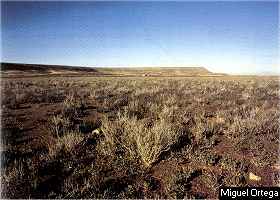
When I went to Vegas and I was sitting on the 22nd floor of the MCM Grand hotel, my memories brought me back to my childhood. I remember when, as a child, we went through the dessert-like landscape in Los Monegros, a county in Saragossa (Aragon) that resembles a lot the surrounding areas of Vegas.
I thought that it would be great that Catalonia starts to invest in Los Monegros and creates a "Las Vegas" type of set up with nice hotels, celebrity shows and "bullfight arenas".
You know that I am totally for banning bullfighting in Catalonia as soon as possible for two main reasons: first, it has nothing to do with our culture (we only have it now to satisfy the appetite of misguided tourists), second, because I think Catalans should not support an activity where people get excited watching an animal suffer. For those reasons I am hoping that the Catalan parliament will pass a law forbidding bulfighting in the Catalan territories (I assume this will happen soon after the new Catalan Estatut is approved. Doing it before that happens,would endanger the objective to have the Estatut passed in the Spanish parliament).
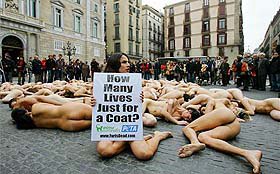
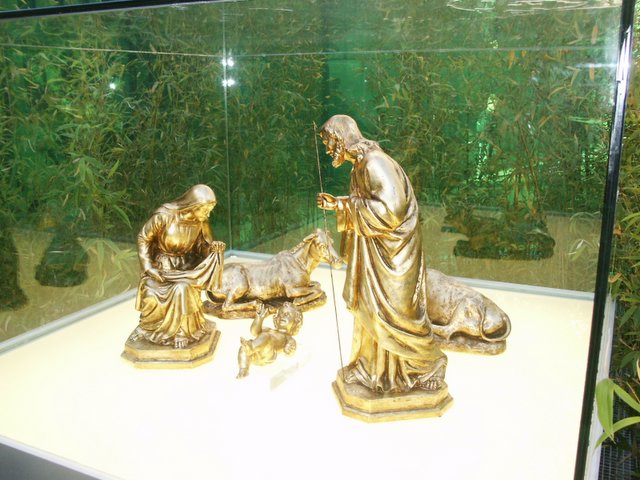
In the picture you can see a protest from the anti-bullfighting party (PACMA) staged in front of the seat of the Catalan government and the Barcelona Town Hall. Surprisingly, this is the same location where the Nativity scene was located. Remember that the "caganer" was banned from that display, what I interpret as: "you can pull down your pants, as long as you keep control of your sphincters".

So why would I like to have bullfighting in Los Monegros? I like Aragon and the people there. Setting up something like a "Las Vegas" there would create employment, would develop the area and would add some additional attractions to the vicinity of Catalonia without having to develop the oversaturated space in the Principality. We could have one or two days tours originating in Barcelona to attend a bullfighting show, a David Copperfield magician-like show and gambling for a while in Los Monegros. I would encourage Catalan businessman to invest heavily in Los Monegros, but do it low key. They should avoid the boycott (or boyCATt) prone hotel names as the Maragall Grand or the Carod-Rovira Imperial Palace. Just invest in hotels and give them standard names (I would even consider Melià Sol as provoking), theaters and other touristic attractions, link them with stays in Catalonia and we are all set.
Some of you maybe asking why do I support bullfighting in Los Monegros and not in Catalonia. Frankly speaking, I think that if bullfighting bulls were asked, they would prefer to continue to die in the arena, rather than being forced fed in overcrowded farms and killed slowly but surely hanging from a conveyor hook in a modern slaughterhouse. Therefore I leave it up to the Spaniards what to do with it, I just want it out of Catalonia. If one day, farm bulls and cows are roaming freely on the prairies for a few years and after that driven in stretched limos to the slaughterhouses, where they are killed through lethal injection after being sedated by an anesthesiologist, I may change my mind and campaign for a ban also in the rest of Spain. In the meantime, let's invest in Los Monegros (Saragossa).

Wednesday, March 15, 2006

I love Virgin

Do not worry! This continues to be a respectful political blog. Note the capitalization of the noun and the fact that is not plural. I am referring to Virgin Atlantic, the airline that belongs to Richard Branson, the eccentric millionaire.
In general, I never fly Virgin Atlantic because of two reasons, I hardly use its partners and its hub is Heathrow. I have tried to avoid Heathrow for 20 years. The terminals are far apart, you need to take a lousy bus to commute from one to another, security guards are very often rude and especially because I felt very offended by the signs at customs when I was there 20 years ago. One of the signs said “Europe and Gibraltar” and the other said “Spain and rest of Africa” (that’s at least what I recall, maybe in reality, it only said “Spain and Africa”, but who cares, the damage was done).
However, last month when I was in Malta, I was called back for an urgent meeting in Boston, and the only way to make it in time was taking Virgin through Heathrow.
Heathrow has not changed much, it is still a lousy airport and the buses are still there. Security guards are nicer, even one of them noted that it was my birthday (February 22nd) and wished me happy birthday!! (isn’t that nice?) and the signs at customs had been removed and replaced by the more neutral “E.U. countries” and “non E.U. countries”.
But that’s nothing compared to the Virgin Atlantic “upper class” (that’s the way they call it) lounge. It is like a high society club. You sit down and a waiter will come to take your order. He will offer you drinks, the menu and will recite the daily “specials”. While he brings you the food, you can help yourself at the Deli counter where I got some fresh sushi and sashimi after booking an appointment with the hairdresser (you can also have a massage, spa, manicure, etc.). All of this free of charge (in relative terms). Let’s say that this is included in the $4000 that you pay for the one way ticket from Malta to Boston. But the luxury does not end there. In the plane, the “upper class” features real individual flat beds (not the almost flat that you find in other airlines) with pillows, bed sheets and blankets. They give you a supercute black pajamas that almost everyone will wear (you change is the toilet, in case you are interested). In addition to that, a “Spice Girl” looking therapist will offer you her services that range from a head massage to finger acupuncture or even a manicure. At first, I politely refused because I had missed the word complimentary (and you know how stingy Catalans are and I was sure my company would not foot the bill), but when I realized that the Scottish guy lying next to me had accepted, I changed my mind while promising myself to work on my British English listening comprehension. After this experience, Heathrow moved twenty places in my airport ranking, I started to wonder whether I had actually seen the sign “Spain and rest of Africa” and I ordered myself a Virgin Atlantic frequent flyer card.
You must be wondering what these last two postings have to do with Catalonia Politics. I will try a hat trick. One of last points being debated in the Catalan Statute is the ownership of the airports. The Catalan government wants to manage them and the central government does not want to give them up. In this case, I fully support the transfer of the Catalan airports to Catalan jurisdiction. Looking at the current events, if we live them to the central government, Barcelona airport will become a provincial airport with a handful of European flights and no intercontinental direct connection.
If I were the Catalan government, I would fight for control and immediately after, I would partner with a good international airline like KLM, Singapore airlines or Cathay (or even Virgin), I would turn Barcelona airport into one of their European hubs and I would pass to them the management of the airport to convert it into a Schipol, Changi or Hong Kong airports. This would make of Barcelona an even more attractive city for leisure and business that would outshadow our archrival Madrid with Iberia that tops the ranking this year of European carriers that have lost more pieces of luggage.
I am now on my way to Sao Paulo in Brazil with United. No pajamas, no masseuses, no haircuts.

Monday, March 06, 2006

Lufthansa, nie mehr!!!

Last Friday I had a terrible day at Frankfurt airport. It was snowing and the flight out of Stuttgart got delayed. My flight to Boston was gone when I landed in Frankfurt and that's when the odyssey started.
I proceeded to the gate hoping that the flight to Boston would also be delayed but it was not. The gate was deserted, no one greeting us, no one with our alternative boarding passes ready, nothing, not a single soul in the vicinity of gate A63.
I quickly proceeded to the business lounge to try to get an alternative routing. After waiting for about 20 minutes, the lady at the business lounge told me that they were not trained to carry out these complex changes (complex!?) and that I should go to the transfer desk in the main terminal. I went through security and waited for 20 minutes at the transfer counter until it was my turn. There they told me that they were not authorized to do this change and that I had to go back to the terminal. I had to control myself to keep calm. I went back through security again, unpacked my laptop, took off my belt, shoes, jacket and so on and went through immigration. It was snowing outside, but I was sweating as if I were in the Sahara desert.
I finally reached the transfer desk in terminal A that had no counter for business class passengers. I queued for three hours, till I got to the counter. In the meantime I missed two possible connections, one through Washington DC and the other through Detroit. After three hours of wait time in line, I got a good connection one through London. Only the people at the transfer desk were working, the rest of the employees servicing the gates, were basically idle, because the airport was operating at 20%. I even saw a policeman talking in these terms (in German) to an American tourist who understandably had lost his temper in the situation: "In Germany, we speak German and we do not need to put up with assholes like you" (the American guy did not understand German and I did not translate for the safety of both of us).
When I was already in the runway and about to fly to London, the pilot said that the de-icing equipment for small planes had broken down and that we had to go back to the terminal. I deplaned and ran to the terminal B transfer counter (someone in the plane told me that in terminal B, they had a transfer counter for business class passengers and it was true). There were hundreds of people in the tourist class line (maybe also 3 hours wait), but it only took me about 20 minutes to get to the service person in my line. I told him that I just wanted to get anywhere in the East coast of the USA, I would handle the rest. I got a flight to JFK late in the evening. I landed in New York at 9.30pm. The customs officers were so nice to me, I felt at home, I must have looked tired. My luggage was lost and is still lost. I had to make the lost baggage report. But I was close to home. A nice rental car was waiting for me with navigation equipment. Everyone was nice to me, everyone smiled at me. I felt happy to call USA my home.
I drove for 3 hours and 45 minutes through New York, Connecticut and Massachusetts. At 2.30am on Saturday I got home and I had to wake up my wife, because my home keys were in the lost luggage. I went to my room and I saw my 2 little kids sleeping in our bed. It was really worth while so much effort to return home for the weekend.

I am going back to Germany in 3 weeks. I have changed my reservation to KLM. Lufthansa nie mehr!! never again!! or at least until the next airline screws up even worse.

Wednesday, February 22, 2006

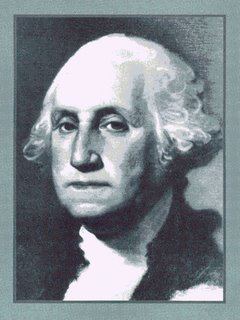
George and I


Today it’s George Washington’s birth anniversary. Yes, the first president of the United States was born on February 22nd, and so was I (a few decades later). I have browsed through Washington’s life to see whether there was any other common characteristic in our lives, but I cannot find any significant coincidence.
However I still have time to add some more common characteristics in our biographies. As you may have guessed, when I go back to Catalonia, I plan to join politics. My intention is to return when I retire, in about 25 years. I may then become the first president of Catalonia, not an independent Catalonia, I still think that this is not the right way to go in the new Europe, but of a Catalonia that has found its sweet spot in Spain and Europe.
Do not ask me what this sweet spot is, I do not know it yet, but I have 25 years and hundreds of blog postings to figure it out. Maybe a nation within the Spanish nation, maybe a US-type state in a federal Iberia, perhaps part of the extended nation of “Baleària” (my politically correct alternative to “Països Catalans” or Catalan countries) formed basically by Catalonia, the Balearic Islands and Valencia with the following main characteristics:
- Name: Baleària
- Capital: Castelló de la Plana (Valencia)
- Language: co-official Catalan and Spanish
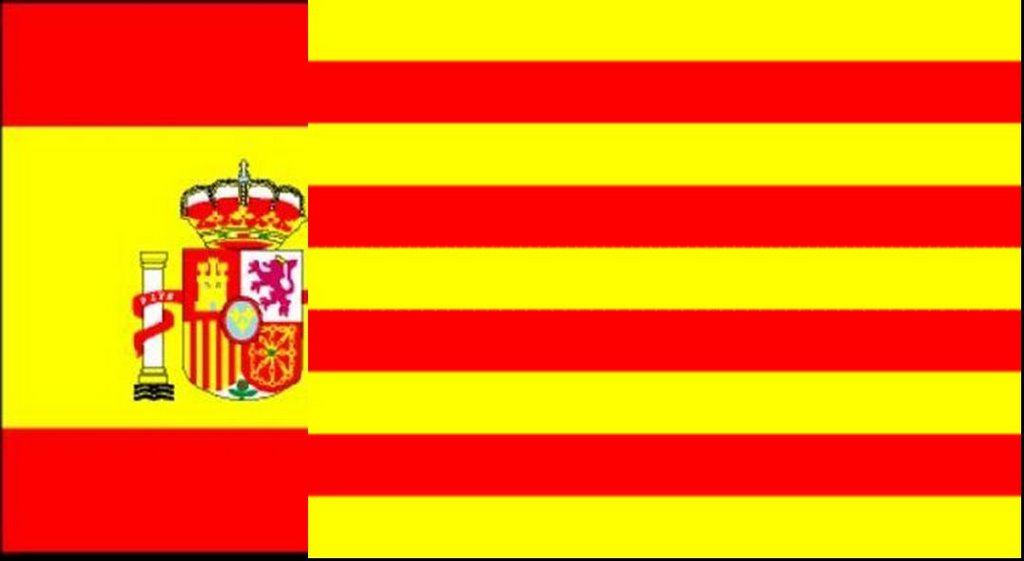
- Flag: equal to the Catalan flag
I am hoping that this compromise would satisfy the majority after reaching a number of trade-offs:
- Name after the Balearic islands, avoiding complex name combinations like Pirineus-Mediterrània (Pyrenees-Mediterranean) or stupid acronyms like Cavaba
- Capital in the old kingdom of Valencia
- The official languages recognize the unity of the Catalan language (Valencian could be used as the unofficial synonym of Catalan, or the variety of Catalan spoken in Valencia as described by the Spanish Language Royal Academy). Spanish would also be official at the same level to warranty the rights of the Spanish speaking and to make sure that Baleària remains competitive in Spain and the Spanish speaking markets
- Flag: the Catalan version of the flag is common to all existing flags.

This could only be possible if politicians like Carod-Rovira and Camps only get a small minority in the parliament and the vast majority vote for people with common sense, like …, I cannot find any name among today’s politicians …., let’s say someone like me.
Baleària would be a part of a federal Spain with only 4 or 5 states, because having 20 states or autonomic regions is hurting the economy now and will hurt it even more in the future due to the unbearable level of overhead and duplications in the public sector that create a non “lean” environment with lots of waste (in the context of a “lean” supply chain that, in my opinion, can be applied successfully to the public sector).

Tuesday, February 14, 2006

2024

Today, February 12th 2024, the European Parliament has rejected a proposal by the Spanish representative to the European Council to re-create the Spanish tax collection agency that was eliminated in the year 2014, when the European tax collection agency was founded with the objective to collect all European taxes, except those from Germany, France, Italy and the Benelux, countries that have kept till today their own tax collection entities, claiming historical rights as founding members of the European Union.
Behind the Spanish proposal, we can find the fact that only 75% of the taxes collected in Spain, come back, while countries like Turkey are taking advantage of the solidarity funds due to partisan reasons, since the votes of its 120 million citizens (one forth of the European Union population) are key to keep the EPP (European Popular Party) in charge of the European government.
Due to its current fiscal deficit, Spain has been obliged to restore the inheritance tax, reintroduce tolls at all statewide highways (that had been eliminated in 2002 in the whole country, except for Catalonia) and institute a 20% co-payment for medical assistance, among other measures.
The Spanish representative explained that after the tax redistribution, the per capita income in Spain dropped four places in the European ranking, after being taken over by Portugal, Czech Republic, Hungary and Latvia. These four countries that still enjoy the solidarity funds, have been able to eliminate the inheritance tax, all medical co-payments and have even introduced free dental coverage.
The Spanish proposal has provoked violent reactions, especially in those four countries and Turkey. Since Spain started to publicize its proposal, several organizations in those countries have called for a boycott to Spanish products, especially, Rioja wine, olive oil and, of course, “cava” (Catalan sparkling wine). Sales of those products in Europe have dropped significantly (about 7%), although the selling season has been saved thanks to the marketing efforts in Asia and the USA, as well as, the sale of non labeled wine and olive oil to Italian companies.
At the same time, some groups in Madrid have started a boycott against products labeled in English, which are invading the shelves of the supermarkets, due to lower distribution costs. England has sent an official complaint to the Spanish regional government and has qualified the attitude of the Madrilenian citizens as racist.
Meanwhile the dispute between the Seville archdioceses museum and the Moroccan government continues. The Moroccan government is demanding the return of all religious objects (Christian and Muslim) that came from the Spanish ex-colonies of Ceuta and Melilla. As you will remember, those colonies were returned to Morocco in 2018, as a result of the pressure from the Turkish government to the European conservative party that needed the support of the Turkish parties to overcome a non confidence vote in the European Parliament. The leader of the Spanish conservative party, who initially signaled his disagreement, was called to Brussels for consultations and despite the fact that there were many rumors about his possible resignation, he finally accepted the party line and voted for the return of the two enclaves to Morocco.
The only positive event this year has been the return of the documents stolen from Madrilenian institutions and private owners by the French troops during the War of Independence in 1808, and that were located at the French National Museum in Lyon. The documents left Lyon in the middle of the night and with heavy escort. The mayor of Lyon has filed an injunction against the Spanish regional goverment that has been accepted by the European court.

A close aide to the expresident of the Spanish government at the beginning of the century, José María Aznar, has indicated that the expresident, in view of the situation, exclaimed in privacy and in Catalan: “We should have learnt from the Catalans”.

Ian Llorens
http://www.ianllorens.com/

Note: This article can only be reproduced if the author Ian Llorens and his website (http://www.ianllorens.com/) are mentioned.


2024
El parlamento europeo ha rezachado hoy, 12 de febrero del 2024, una propuesta del representante español en el Consejo de Europa para recrear la agencia tributaria española que fue eliminada en el año 2014, cuando se fundó la agencia tributaria europea, con el objeto de recaudar todos los impuestos europeos con excepcion de los de Alemania, Francia, Italia y el Benelux quienes aduciendo derechos historicos como miembros fundadores, han mantenido hasta hoy en dia sus agencias recaudatorias.
El fondo de la propuesta se basa en el hecho de que solo el 75% de los impuestos recaudados vuelven a España, mientras que paises como Turquía se están beneficiando de los fondos de solidaridad por motivos partidistas, ya que los votos de sus 120 millones de habitantes (una cuarta parte de los habitantes de la Union Europea) son fundamentales para mantener al Partido Popular Europeo en el gobierno de la Unión.
Debido al deficit fiscal, España ha tenido que restablecer el impuesto de sucesiones, los peajes en todas las autopistas del estado (que a excepcion de Cataluña, se habian eliminado en casi todo el pais en el año 2002) e introducir un copago del 20% en la asistencia sanitaria, entre otras medidas.
El representante español argumentó que tras la redistribucion de impuestos, la renta per capita de los españoles perdía 4 lugares en el ranking europeo, viendose sobrepasada por Portugal, Chequia, Hungria y Letonia. Estos cuatro paises que todavía se benefician de los fondos de cohesion, han podido eliminar el impuesto sucesorio, los copagos en la sanidad y han incorporado la cobertura dental gratuita.
La propuesta española suscitó violentas protestas, especialmente en esos cuatro paises y en Turquia. Desde que España hizo publica su propuesta, varias organizaciones de esos paises han hecho llamamientos al boicot de productos españoles, especialmente el vino de Rioja, el aceite de oliva y como no, el cava. El descenso de ventas de esos productos en Europa ha sido notable (un 7%), aunque la campaña se ha salvado gracias al esfuerzo comercial realizado en Asia y en Estados Unidos y a la venta de vino y aceite sin etiquetar a empresas italianas.
En Madrid, a su vez, se ha iniciado un boicot contra los productos etiquetados solo en inglés, que estan invadiendo nuestros supermercados dado los menores costes de distribucion. Inglaterra ha enviado una protesta formal al gobierno regional español por esta actitud de los madrileños calificada por el representate inglés como racista.
Entre tanto la disputa entre el museo diocesano de Sevilla y el gobierno de Rabat continúa. Rabat reclama la devolución de todos los objetos religiosos (cristianos y musulmanes) procedentes de las excolonias españolas de Ceuta y Melilla, que como recordaran fueron devueltas a Marruecos en el año 2018 debido a las presiones de Turquia al gobierno conservador europeo quien necesitaba el soporte de los partidos turcos para superar una moción de censura. El lider del partido conservador español, quien inicialmente mostro su disconformidad, fue llamado a Bruselas y a pesar que se rumoreaba su dimisión, aceptó finalmente la disciplina de partido y voto a favor de la devolución de los enclaves a Marruecos.
La unica nota positiva este año ha sido la devolucion por parte del Archivo Nacional Francés de Lión, de los documentos robados por las tropas francesas a instituciones y particulares madrileños durante la guerra de la independencia de 1808. Los papeles salieron de Lion escoltados y de noche. El alcalde de Lion ha interpuesto una querella contra el gobierno regional español que ha sido aceptada a tramite.
Un colaborador allegado al expresidente del gobierno español de principios de siglo, José María Aznar, ha comentado que el expresidente, a la vista de la situación, habia exclamado en la intimidad y en catalán: “Deberíamos haber hecho caso a los catalanes”.

Ian Llorens
http://www.ianllorens.com/


Nota: Este artículo sólo puede ser reproducido si se menciona al autor Ian Llorens y a su lugar de red (http://www.ianllorens.com/).

Thursday, February 09, 2006

The first boycott lasted 300 years!!!

Last year results show that the boycott against Catalan products has had a negative effect on the sales of, at least, one of our flagship products: "Cava" (Catalan sparkling wine). Sales in Spain dropped by almost 7%, and if you take into consideration that the market grew and that, in some areas, consumption went up, it means that sales in the hardcore boycotting regions (Castilia, Valencia and Murcia) may have gone down by 15% or 20%. Fortunately exports offset this reduction and the top line remained almost flat (slightly up).
Boycotts can have very damaging effects to the economy, especially for those activities that are more hardly hit. I remember the boycott against French products when I was living in Singapore, as a result of their nuclear test at Mururoa atoll. Restaurants around the world boycotted French products. For example, Beaujolais wine was a product that was particularly targeted. DeBoeuf Beaujolais had more than 44,000 cases cancelled. In 1995, tourism to France declined by 8% while Club Med's resorts lost $1 million in profits. At the same time South African, Chilean, Australian and Californian wines, among others, seized a substantial part of shelf space in the wine shops and grocery stores that would not give away after the boycott ended.
However, we Catalans should really learn from this experience not by giving in (we are not dropping bombs, just defending out identity as a people) but by diversifying our markets. Sales to the Spanish market should be below 25% of our output. We are so vulnerable having most of the eggs in the same basket. I also think that Codorniu and Freixenet (the main producers of "cava') should buy those non Catalan cava producers that have a better quality product.
On the other side, this is not the first time that Castilia initiates a boycott against Catalonia. Even before Spain was formed, in 1486, the year in which Columbus reached Spain, the Catalans were expelled from the Casa de Contratacion, the commercial centre of Seville, which in 1504 would get exclusive rights of trading with America.
Before dying in 1504, Isabel added an appendix to her will , stating that Catalans were not only excluded from enjoying the benefits of the great discoveries, but were even forbidden to settle in or trade with the new lands.
My interpretation is that the hatred of Isabel against Catalans was due to their obstinate refusal to embrace the Castlian Inquisition and we paid the price.
It was not until 1778 that this prohibition was cancelled by Charles III who came from Naples, imbued with European ideas.
During almost 300 years, Catalonia fell into the dark ages, while the rest of Europe benefited from the discovery thanks to the Dutch, Portuguese, Genovese and Hanseatic merchants and businessmen who settled in Seville. Most probably this also shaped our spirit as a nation, creating entrepreneurss who had to rely on their own work and not on the wealth coming from the colonies and that's why Catalonia was the only area in the Iberian peninsula that did not miss the boat of the industrial revolution.

To finalize and before I go and buy some Danish pastry (I understand that some countries are calling for a boycott against Danish products), I will add the picture of a poster dated 1932 that many of you must have seen this week in the Catalan press, calling Castilians to boycott Catalan products while the first Catalan "Statute" was being debated, yes, 1932. It is worth while reading.


Note: Some of the historical data has been extracted from Josep Trueta's Spirit of Catalonia, 1946.

Saturday, January 28, 2006

Thanks God, the judge understood Catalan!!!

The judge who was handling the case of Iu Forn, the journalist of the Catalan-language newspaper Avui, who wrote an article called "Manual of a good coupist", has decided to file the case and not to press any charges. The reason given for dismissing the charges is that the article refers to hypothetical military “coupists” (and his mothers) that want to destroy the constitutional and democratic regime that we have today, and it does not refer at all to the current democratic military institution in Spain.

The right wing press manipulated the article to give the impression that Iu Forn was referring to the whole Spanish military when he, in a more or less subtle way, insulted their mothers, when it is clear from the article that he was referring to the mothers of potential participants in a coup d’Etat against the democratic institutions.

That’s why it is so good to have in Catalonia, judges, policemen, teachers and lawyers who understand our language.

Judge by yourself. I have tried my best to make a literal translation of the article. You can find the Catalan original here.

Manual of a good “coupist” - "Manual del bon colpista"
Forward it

(Iu Forn Jan 12th, 2006. Diari Avui)
(Free translation by Ian Llorens)

We suffer a pandemic disease of high ranking military officials (most probably absinthe liquor[1]) who do not like the new Catalan “Estatut” [2] . This is to say that since they are a little angry, they spend their time threatening us by saying that they will take over the streets with their tanks.. Ok, either they take over the streets or they shut up (for ever). And if finally they do what they have historically done, let me give them a small piece of friendly advice:

If they enter Barcelona along Diagonal avenue [3], please park your tanks and get on the tram, that you are in an environmental friendly city.

Once at the Diagonal Avenue, you will see on your right hand side, the “La Caixa” headquarters [4] those who are trying the hostile takeover [5] and want “Espain”[6] to starve to death. It is evident that it is worth while trying to seize it. But, be very careful!!! If you find a tall and blond girl in an office, do not bother her. She could well be the King’s daughter who works there [7].

If while ransacking the city, you decide to take away some documents, you ‘d better wait for the ones on the way back from Salamanca [8] to come back. It you take them away together, you will make better use of the transportation and you will save a few bucks, what’s always good.

Please remember that the new civic ordinance in Barcelona prohibits prostitution in certain cases. For this reason, you’d better come without your mothers. [9]

Important warning: do you know that the Financial Times, the newspaper that last Tuesday said that article 8 of the Spanish Constitution [10] is “not perfect”, also said that the desire to be a nation is a democratic quest and that the attitude of the Popular Party vis-a-vis the general Mena [11] case could be a bigger threat to the unity of “Espain”[6] than the autonomy ambitions of Catalonia? So this newspaper is not Catalan. If you want to bomb it, you need to call the UK yellow pages and ask them for the address.

Oh! Another important thing that I almost forgot. Please do not pay attention to the words of the Spanish Supreme Court chairman. As soon as you arrive, sign up for some flamenco dance lessons, otherwise you may end up learning Catalan [12].


[1] The Catalan word for ranking (“graduació”) is also used to describe the alcohol content of an alcoholic drink
[2] Statue or Constitution
[3] One of Barcelona’s main arteries
[4] The most powerful Catalan savings bank
[5] Gas Natural, a “La Caixa” group company is trying a hostile takeover of Endesa, a Madrid based energy company
[6] Iu Forn uses the word Ej-paña, Castilian dialect for Spain
[7] King Juan Carlos’s daughter, Cristina, works at La Caixa
[8] The central government recently decided to return to Catalonia the documents that were stolen during the civil war and that were stored at Salamanca’s national archive. This has caused outrage in the rest of the nation.
[9] This is the sentence that caused commotion in Spain after having been maliciously translated by the right wing media as being applied to all Spanish military personnel, when it is clearly applied to potential participants in a hypothetical military coup.
[10] This article states that the Spanish military needs to preserve the unity of the Spanish territories
[11] General Mena said that if the Catalan “Estatute” were approved, the military should intervene
[12] The chairman of the Spanish Supreme court said a few weeks ago that learning Catalan language was comparable to learning “Sevillanas” (a variety of flamenco dance)

Saturday, January 21, 2006

Politics is fun, ... sometimes


Apparently, the leader of CiU (Artur Mas) and Jose Luis Rodriguez Zapatero have brokered a deal on the content of the new Catalan Estatut. Even though it is too early to call, it seems that Artur Mas has followed my advice and given priority to the financial aspects of the reform. It appears that we are only a nation in the preface. The text will run more or less like this: "the Catalans are a group of individuals that believe that they are a nation, so let them dream". The validity of the term nation in the preface seems to be very limited. My deep knowledge of Catalan law tells me that it may mean that we are a nation only on those Sundays when Barcelona Soccer club plays at home and on our national day.

It is obvious that Politics is a joke, most of the time. For this reason I will finish with a political joke (free translation from the Spanish original) that L1 sent to me last week (some of you may have seen it also when 'my other me' was fighting an American hawk that insulted the Spaniards, yes, the Spaniards) :

"This is the first day of school at a US high school when the teacher introduces a new student called Akito Suzuki, son of a Japanese business man.
The teacher starts the American history class by asking who pronounced the sentence 'Live free or die'.
Suzuki quickly raises his hands and replies 'Patrick Henry 1775'.
'Excellent' says the teacher and continues 'who said -Government of the people, by the people, for the people, shall not perish from the Earth-'.
The whole class remained silent until suddenly Suzuki said 'Lincoln 1863'.
The teacher was flabbergasted and said to the whole class: 'you all should be ashamed. Akito Suzuki, who just arrived in our country, knows more history than you, Americans'.
Then someone in the rear of the classroom whispered: 'To hell those damn Japanese'.
'Who said that?' The teacher inquired.
Again Suzuki raises his hand and says: 'General McArthur, 1942 and Lee Iacocca, 1982'
The whole class was silent when one of the students said: 'I am going to throw up'.
The teacher asks again this time: 'Who said that?'
Without hesitation, Suzuki says: 'George Bush Sr. to the Japanese prime minister 1990'.
One of the students totally mad shouts at Suzuki: 'Suck my dick'.
Akito intervenes again: 'Bill Clinton to Monica Lewinsky 1997'.
At this point in time, the smartest guy in the class yells: 'I was the first until this bloody Japanese arrived'.
And Suzuki answered: 'Mario Vargas Llosa, Peruvian elections 1990'.
The whole class became hysterical, the teacher fainted. The students gathered around the teacher and said to one another: 'We screwed up, now how do we get out? '
And Akito Suzuki said: 'Jose Luis Rodriguez Zapatero, 2005/2006'.

Cartoon: Ventura & Coromina. La Vanguardia

Monday, January 16, 2006

Some guidance on Language


Before I elaborate on why I think that Catalans should start investing in Los Monegros (Saragossa = Zaragoza) and develop a Las Vegas type of environment, I will touch on the language issue for a little while.
I get mad when I read the ABC newspaper. It is strictly an anti-Catalan forum. They only publish articles and letters that denigrate Catalonia and the Catalans, and at a lesser extent, the Basques. It is no secret that this is where they got its name (Anti Basque and Catalan) or maybe I made it up?
However I have to admit that Catalan politicians are clearly misguided. They show daily their provincialism and lack of global approach.
First a couple of facts:

  • The traditional language in Catalonia is Catalan and it has been Catalan for the last 1000 years. Before that, Latin was the language that the previous invaders, the Romans, imposed on the Iberian peninsula. As far as I know, no one in Catalonia is mad at the Romans or their direct heirs, the Italians.
  • When Catalonia lost the Succession War in another tragic September 11th, Philip V's decree of new foundation (January 1716) was the start of the penetration of Castilian (=Spanish) in the Catalan territories, especially Barcelona.

But, by now, all this is history and we need to be pragmatic and smart. Spanish started as an imposition, but in the course of the centuries, it has become an asset. That's why Barcelona is the city where, most probably, more books in Spanish are published every year.

So Mr Maragall, Mr Carod-Rovira, Mr Mas and company. Here a piece of advice:

  • Invest all the additional money you can get as a result of the new "Estatut" in education. Make sure that every single resident in Catalonia is fluent in Catalan, Spanish and ENGLISH. Do it quietly, it will take 15 years to get the next generation up and running, but DO it.
  • Make sure that all students get at least 40% of their education in either Spanish or Catalan, not a Catalan only education with one hour a week of Spanish.
  • At the University, all studies should be offered in Catalan and Spanish. Students should make the decision. This way we would be able to attract talent from other parts of the world, what would generate more income to be reinvested in our education system and hopefully some of the students would settle in Catalonia increasing our brain power. I would also suggest some of the curricula be taught in English to increase the cross-fertilization even further
  • We should recognize that Catalan outside Catalonia, the Balearic islands and Valencia is useless. It is a beautiful language that I love with all my heart, but is certainly useless outside the territories where it is spoken
  • We should not try to impose it outside those territories. It will cause not only rejection, but it will be detrimental for our economy. Sending invoices or other paperwork in Catalan to non Catalan speaking customers outside the areas I mentioned before is not only disrespectful but also the fastest way to commit economic harakiri. Customer should always be first and if they want the invoices in Swahili, we should provide them
  • We should not campaign to get Catalan in the European institutions. We should lobby to remove all languages but English from the European institutions as a way to get a lean European public sector. Only English should be spoken there, all master documents should be English, all public servants and bureaucrats should master English, otherwise they should lose their European job (we can give them some transition time to adapt, like a month or two). Who can get a job in a multinational if he or she does not speak English fluently? Translation to local languages should be undertaken by the respective countries and regions. So the Catalan government could run the Catalan EU website with all translations in Catalan, the same as the Spanish government, the French, the Danish or the Maltese (obviously UK and also Ireland should contribute with some cash, otherwise it would be a free ride for them)
  • In Catalonia, Catalan should be used as a way to promote the economy. Everything should be customer driven. If customers demand Catalan, localization in Catalan should be required. If you come to invest or you are a tourist or visitor, you can speak in whatever language you want or use smoke signals, that we will understand you.

So please, politicians, get me the money, do not squander it (you know, the 3% commissions and things like that), start spending heavily in education and shut up for 2 or 3 or 15 years. Once you deliver, you can open your mouth again.